The 2019 fire had one unintended upside: the restoration gave the interior of Notre-Dame a brightness no living visitor had ever seen. The cleaned stone is pale gold again, all 42,000 m² of walls and vaults have been freed of dust, and the chapels have recovered their 19th-century painted decoration. Here is the route, in the actual order of the visit.
The nave: 127 metres of Gothic reborn
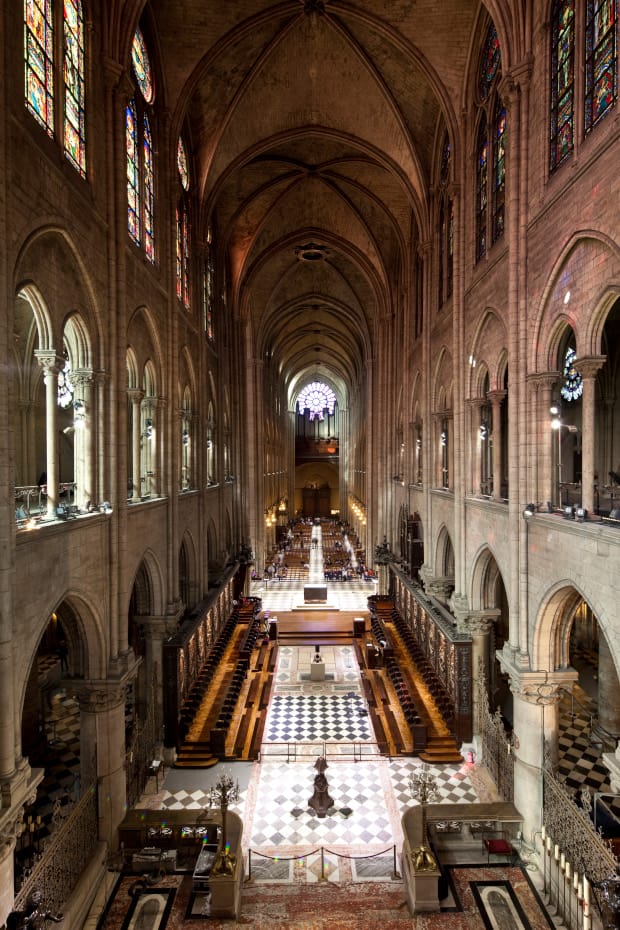
Once through the Portal of the Last Judgement, the effect is immediate: 127 m long, 48 m wide, 33 m under the vaults, ten bays punctuated by pillars the restoration has left almost luminous. Look up at the new vaults, rebuilt exactly as they were — solid oak and the know-how of medieval-style carpenters — then move along the right-hand aisle, the direction of the visitor circuit.
The three rose windows: the pinnacle of Gothic stained glass
The north and south rose windows (transept, c. 1250–1260) measure nearly 13 metres across; the north rose still holds most of its original medieval glass. The west rose, older (c. 1225), can be glimpsed behind the great organ. A tip on light: the north rose is superb at any hour (constant light), while the south rose blazes in the late afternoon. The windows of the upper chapels mix 13th-century glass with 19th-century creations.
The great organ: 8,000 pipes saved from the flames
The great organ — nearly 8,000 pipes, 115 stops, five keyboards, the largest in France — survived the fire but not the lead dust: dismantled pipe by pipe, cleaned and re-voiced over four years, it has been sounding again since December 2024. To hear it: Sunday Masses and the recitals announced on the official website (see opening hours).
Choir, Pietà and Cross of Glory
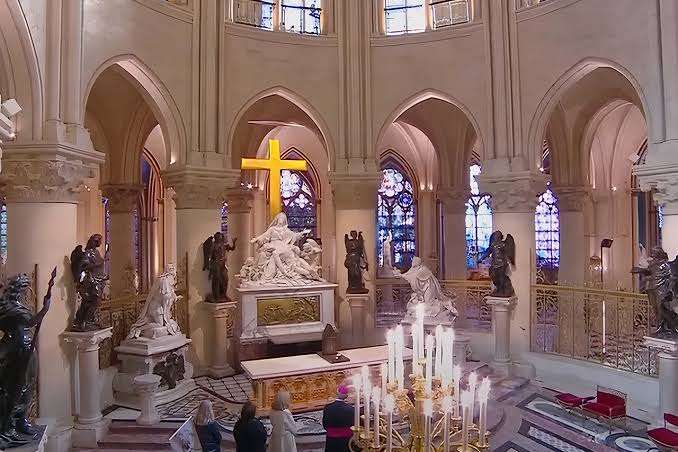
At the far end of the choir, the Pietà by Nicolas Coustou (1723), commissioned in fulfilment of Louis XIII's vow, stands out against the gilded Cross of Glory — one of the most photographed images of the restored cathedral. Around it: the 18th-century choir stalls, the statues of Louis XIII and Louis XIV, and the carved 14th-century choir screen with its painted scenes from the life of Christ, meticulously restored.
The chapels and the "Mays"
The 29 restored side chapels have recovered their painted decoration — including the baptistery chapel with its starry ceiling. Several house the "Mays" of Notre-Dame: large paintings donated by the goldsmiths' guild in the 17th century (Charles Le Brun, Laurent de La Hyre and others), returned to their places after restoration. The new bronze liturgical furnishings (altar, ambo, cathedra) by Guillaume Bardet and the contemporary reliquary for the Crown of Thorns designed by Sylvain Dubuisson set today's creativity in dialogue with the Gothic.
The Crown of Thorns and the treasury
The cathedral's most venerated relic, the Crown of Thorns — rescued from the flames in 2019 — is presented to worshippers and visitors every Friday from 3 PM to 5 PM, free of charge. The rest of the time, head for the treasury (€6, in Viollet-le-Duc's sacristy): reliquaries, liturgical goldwork and mementoes of the cathedral's great moments, from Napoleon's coronation to papal visits. Detailed prices here.
What you won't see (yet)
- The archaeological crypt beneath the parvis is a separate site (a City of Paris museum, paid entry) — recommended for anyone fascinated by ancient Lutetia.
- The roofs and the spire cannot be visited; the best view remains the one from the towers (€16) or from the banks of the Seine.
- Some chapels may be temporarily closed: the final works continue in rotation until 2026.
Making the most of the interior: three tips
- Follow the direction of the circuit (right aisle → ambulatory → left aisle): go against it and you'll be swimming upstream against 30,000 daily visitors.
- Photos are allowed without flash or tripod — be respectful of worshippers, especially during services.
- An audio guide (€6) or a guided interior + exterior tour (~€35) turns the stroll into a real reading of the monument; allow 1.5–2 hours in that case.
Frequently asked questions
Can you visit the interior of Notre-Dame for free?
Yes: the nave, chapels, choir and ambulatory are free to enter. Only the treasury costs money (€6). The free time-slot reservation lets you skip the queue.
What is there to see inside Notre-Dame?
The three 13th-century rose windows, the great organ with its 8,000 pipes, Coustou's Pietà, the Cross of Glory, the 29 restored chapels with the "Mays" paintings, the medieval choir screen and the treasury.
Can you see the Crown of Thorns?
Yes, every Friday from 3 PM to 5 PM during the veneration, free of charge, in its new reliquary designed by Sylvain Dubuisson.
Can you take photos inside Notre-Dame?
Yes, without flash or tripod, and with respect for religious services. The best light: the south rose window in the late afternoon, the choir in the morning.
How long does it take to visit the interior?
45 minutes to 1 hour self-guided, 1.5 to 2 hours with an audio guide or guided tour, plus 20–30 minutes if you add the treasury.
Is the interior accessible to visitors with reduced mobility?
Yes, the cathedral is step-free and wheelchair-accessible through the main entrance; only the towers (424 steps, no lift) are not.